Road spotlight ·
The Route Napoléon in November: Open All Winter, With New Rules
The high Alpine passes are shut, but the Route Napoléon stays open. What France's winter equipment rule, in force since 1 November, means for the drive.
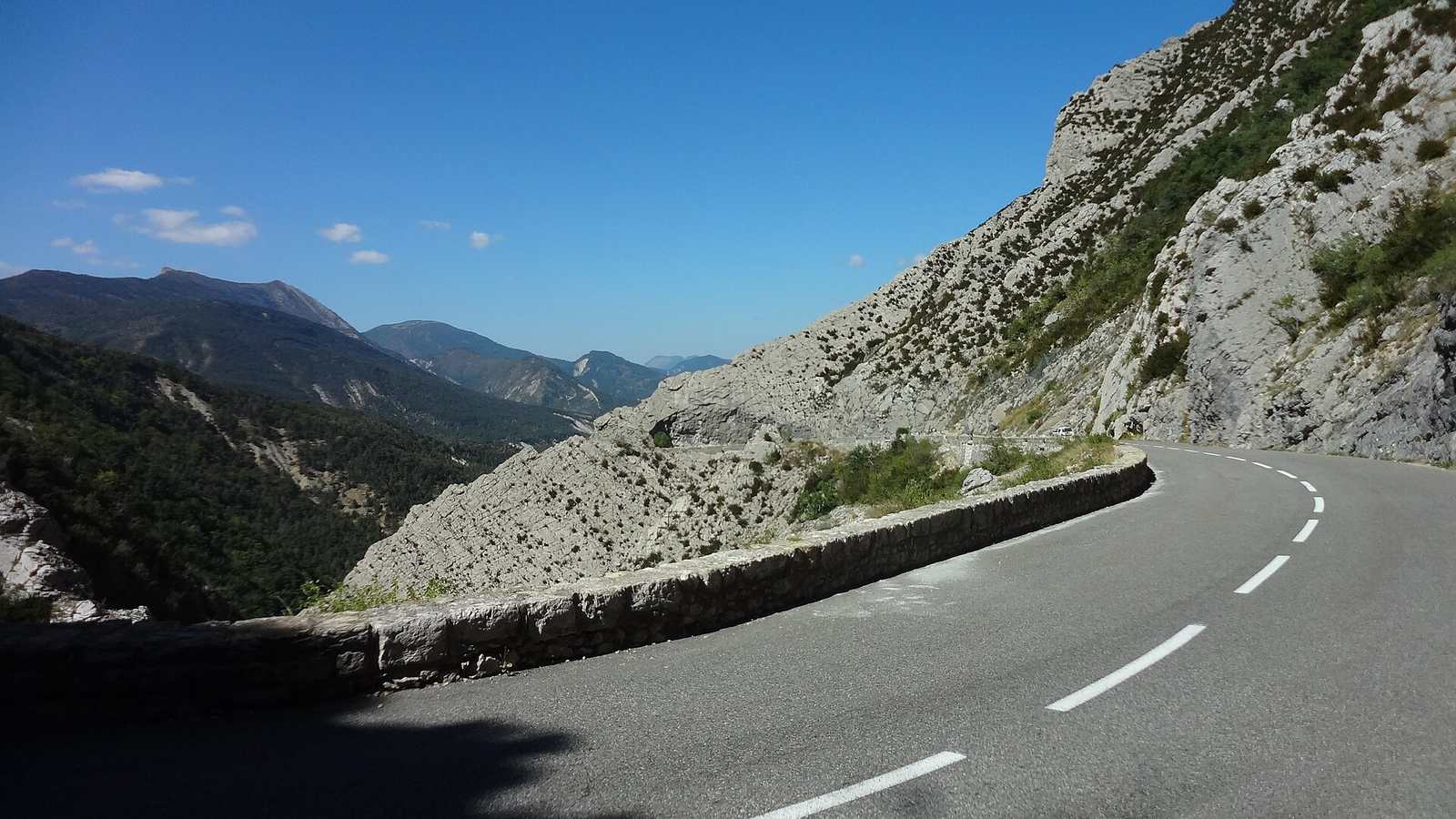

By November most of the great Alpine passes are closed for the winter. The Route Napoléon is not one of them. It is a main road, kept open all year, and its best section, from Grasse to Castellane, stays below about 1,200 m. There is one thing to sort out before you go. Since 1 November, France’s winter equipment rule (the Loi Montagne) is back in force in the mountain areas the road runs through.
What the rule says
From 1 November to 31 March, cars driving in designated mountain areas must either have four winter tyres or carry chains or textile snow socks that fit at least two driven wheels. Since 2024, a winter tyre only counts if it carries the three-peak mountain snowflake symbol (3PMSF). Tyres marked only M+S no longer qualify.
Each prefecture decides where the rule applies. The Hautes-Alpes, which the road crosses around Gap, is covered as a whole department. In the Alpes-Maritimes, the Alpes-de-Haute-Provence and the Isère, only listed communes are covered, so check the prefecture lists for the towns on your route. The rule applies to every road in a listed commune, not just the ones up to ski stations.
Connexion reports that no decree setting a fine has yet been published, and that the interior ministry has described enforcement as educational. It also points out that an insurer may take a dim view of a claim if the car was not equipped as required.
What that means in a Porsche
Most 911s and 718s run on summer tyres, which carry neither marking. If you are on summer tyres, the simplest answer is a set of snow socks in the boot. They are light and easier to fit at the roadside than chains. Check that they are approved for your tyre size first, as clearance around wide rear tyres can be tight. Our winter tyres post covers the case for a proper second set.
Driving it now
Grasse to Castellane is the section to drive, over the Col de Valferrière (1,169 m) and the Pas de la Faye. In November the summer caravans and most of the weekend motorcycle traffic have gone, and the road is quiet on weekdays. Mornings can be cold at altitude, with damp or frost in the shaded corners after a clear night, so give the tyres time to warm and take the first few kilometres gently.
North of Castellane the road goes through the Clue de Taulanne towards Digne, then on through Sisteron and Gap and over the Col Bayard to Grenoble. That northern half is higher and more exposed, and is where snow is most likely as winter goes on.
Our road trip preparation guide has a checklist for a longer run, and the Col de Turini, in the hills above Nice, is a tighter road for the same trip.
Source: Connexion France, “Loi Montagne: where will winter tyres be mandatory from November 1”