How to Prepare Your Porsche for a Road Trip
What to check, what to pack and what to expect when you take your Porsche a long way from home.
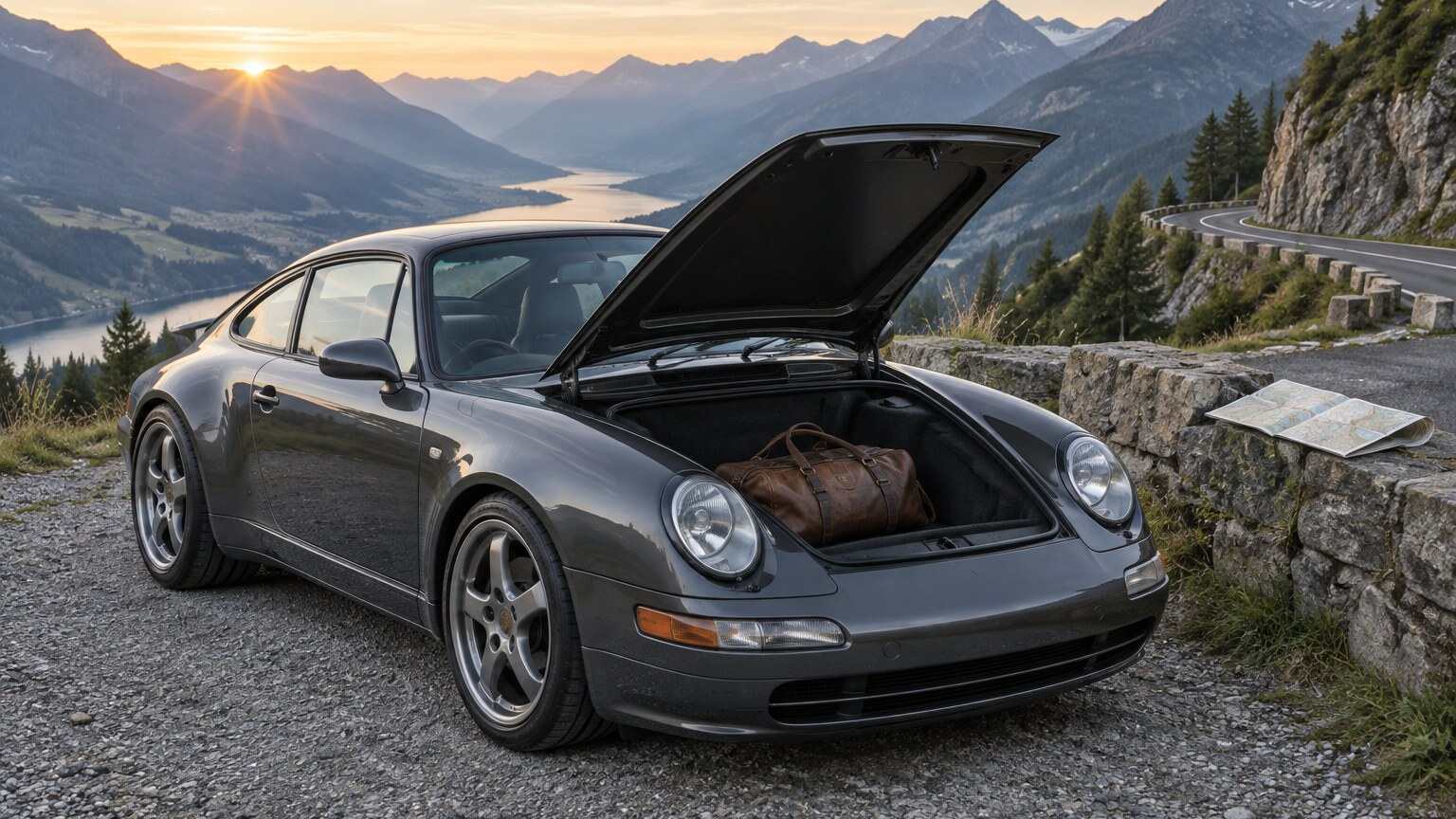
A Porsche is one of the easiest sports cars to take a long way. Owners drive 911s from Britain to Sicily, Boxsters across the United States and Taycans over the Alps every year. The cars are built for it. What needs thought is mostly the same on every model: the car is low, wide and on performance tyres, and the roads you are going to are narrow, steep and a long way from a dealer.
Before you leave
Do these a couple of weeks ahead, so there is time to fix what you find.
- Tyres. Check tread across the full width, especially the inner shoulders of the rears, which wear first and are hard to see. Look at the date code. Track-biased tyres such as the Michelin Pilot Sport Cup 2 work poorly in standing water and cold weather. For a tour that might see rain at 2,000 m, a conventional summer tyre is the safer choice. Porsche approves specific versions of tyres, marked N0, N1 and so on; fit matching sets.
- Brakes. Fresh fluid is the single most useful thing you can do before a mountain trip. Long descents boil old fluid. Check pad depth and the pad wear sensors. Carbon-ceramic discs (PCCB) resist fade very well, but their pads still wear and the discs are costly to replace if chipped.
- Cooling. The radiators and air conditioning condensers sit low in the front corners on water-cooled cars and collect leaves and grit. Have them cleaned out if it has not been done. Check the coolant level when cold.
- Oil. Check the level by the method your car uses, dipstick or electronic, and carry a litre of the approved grade. Some engines, including the GT3’s, use a noticeable amount when driven hard.
- Battery. A weak battery shows itself on the first cold morning at altitude. Modern cars are sensitive to low voltage.
- Geometry. If the car is on aggressive track settings, a road alignment will make it more stable on motorways and kinder to tyres.
- Recalls and software. Ask a dealer to check the VIN for outstanding campaigns before a long trip. See the recalls guide.
Air-cooled and classic cars need a more thorough look: fuel hoses, ignition parts, fan belt, oil leaks, and a spares kit to match.
Ground clearance and width
Standard 911s and 718s cope with most roads. GT3, GT4 and other lowered cars have long front splitters and little clearance.
- Approach ferry ramps, car park entrances and hotel driveways at an angle.
- If the car has front axle lift, use it, and remember that it lowers again automatically above a set speed.
- Tell the ferry or train loading crew that the car is low. They deal with it every day.
- Watch for speed humps in alpine villages, which are often steeper than they look.
Width matters as much as height. A current 911 is about 1.85 m wide before the mirrors, and a Cayenne or Taycan is wider still. On single-track roads and old alpine passes, fold the mirrors when you squeeze past a coach, and pull in early. Alloy wheels sit proud of the tyres and are easily kerbed on stone-edged hairpins.
Fuel, range and charging
A 911 has a tank of about 64 litres, with a larger one optional on some models, and a 718 about 54 or 64. On the motorway that is 500 km or more. In the mountains, plan on much less and fill up before you start a pass, not at the top of it. In rural France and Italy many stations are unmanned at lunchtime and on Sundays and take cards only.
Porsche engines are designed for 98 RON fuel. They will run on 95, with slightly reduced performance, but use the higher grade where you can.
For a Taycan or a plug-in hybrid, plan charging around valley towns and overnight stops. Climbing uses a lot of energy; the descent gives some of it back. Check that your charging cards and apps work in each country on the route.
Packing
- A 911 has a front boot of roughly 130 litres and the rear seats, which fold to make a useful shelf. Two people can pack for a week.
- A 718 has a boot at each end. Soft bags make far better use of both than hard cases. The rear boot gets warm, so keep chocolate, electronics and medication elsewhere.
- A Targa or Cabriolet has less space behind the seats when the roof is stowed.
A sensible touring kit:
- Tyre sealant and compressor (most cars have no spare wheel), and the locking wheel nut key
- One litre of engine oil
- The towing eye, warning triangle, high-visibility vests and whatever else local law requires
- A microfibre towel, and a soft brush for clearing radiator intakes
- Paper maps of the mountain areas, where phone coverage is unreliable
On the road
Altitude. Naturally aspirated engines lose roughly 10 per cent of their power for every 1,000 m. A GT3 or an older Carrera will feel it on the Stelvio. Turbocharged cars lose far less, and electric motors lose nothing.
Descents. Use the gears, or the PDK’s manual mode, and brake firmly and briefly instead of dragging the pedal. A Taycan recovers energy on the way down.
Rear-engine manners. A 911 puts its power down very well out of slow corners. It is less forgiving if you lift off sharply in the middle of a wet bend. Brake in a straight line, turn in, and accelerate out. The stability systems are good; leave them on for public roads.
Fatigue. An hour on a hairpin pass is more tiring than it feels. 300 km with a couple of passes is a full day.
Weather. Snow is possible on the high alpine passes in any month. Summer tyres lose grip quickly below about 7 °C. Check the pass status in the morning before you commit to a route.
Security. Choose hotels with off-street or underground parking where you can, and check the ramp angle first.
Paperwork
For cross-border trips carry the registration document, insurance certificate and your licence. Check that your policy covers every country on the route, and read the wording on track use and on toll circuits such as the Nürburgring Nordschleife, which many policies exclude. Switzerland and Austria need a motorway vignette; several countries have low-emission zones that require a sticker ordered in advance. Porsche Assistance or your own breakdown cover should include recovery to a dealer, not just to the nearest garage.
Where to go
Start with the trail guides. For a first European tour, the Stuttgart loop and the Black Forest High Road on the way down, then the Furka, Grimsel and Susten loop, the Stelvio Pass and the Grossglockner make a week that is hard to beat.