Rear-engined coupé, cabriolet and Speedster
Porsche 356
1948–1965
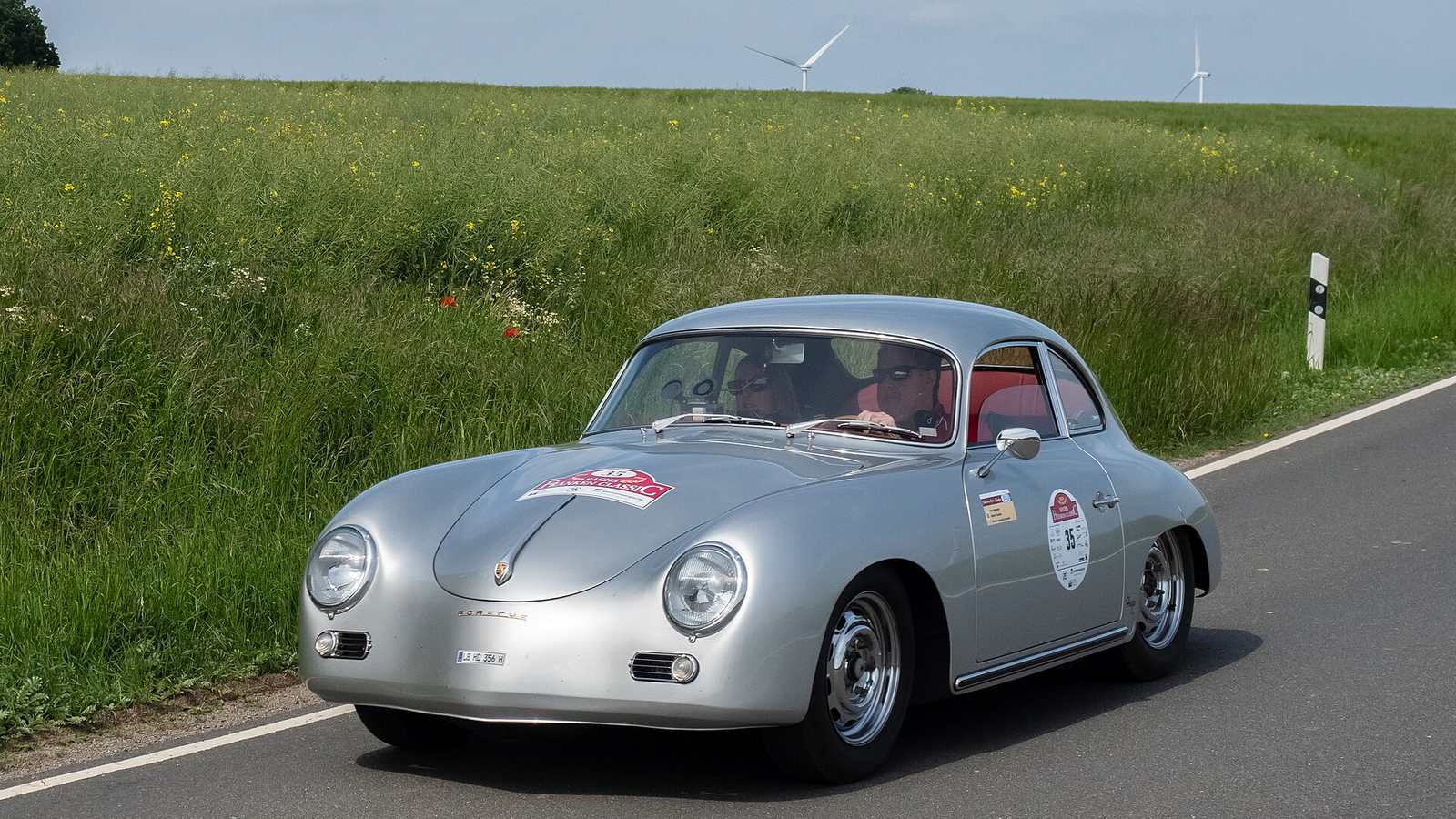

- Years
- 1948–1965
- Engine
- 1.1 to 2.0 air-cooled flat-four
- Power
- 40–130 PS
- Weight
- about 770–1,010 kg
The 356 was the first car sold under the Porsche name. The prototype, a mid-engined aluminium roadster known as 356 No. 1, was registered in June 1948 at Gmünd in Carinthia, where the design office had moved during the war. The production cars that followed put the engine behind the rear axle, and the first fifty or so were built by hand at Gmünd with aluminium bodies.
In 1950 production moved to Stuttgart-Zuffenhausen, with steel bodies made by the coachbuilder Reutter. The car began with Volkswagen-derived mechanical parts and steadily became more of a Porsche: the engines grew from 1.1 to 1.6 litres, a full synchromesh gearbox arrived, and the final 356 C had disc brakes on all four wheels. Around 76,000 were built in total.
The Carrera name first appeared on a 356. It marked the cars fitted with Ernst Fuhrmann's four-cam racing engine, and commemorated Porsche's class wins on the Carrera Panamericana road race in Mexico in 1953 and 1954.
Variants
| Variant | Years | Notes |
|---|---|---|
| 356 (Pre-A) | 1948–1955 | Split or bent windscreen, 1.1 to 1.5 litre engines. |
| 356 A | 1955–1959 | Curved one-piece screen, 1.6 litre engine available. |
| Speedster | 1954–1958 | Low screen, minimal hood, built at the request of the US importer Max Hoffman. |
| 356 B | 1959–1963 | Raised bumpers and headlamps; Super 90 engine. |
| 356 C / SC | 1963–1965 | Disc brakes all round; SC with 95 PS. |
| Carrera | 1955–1965 | Four-cam engine, up to 130 PS in the 2.0 litre Carrera 2. |
On a road trip
A 356 is light, narrow and geared for mountain roads, which makes it better company on an alpine pass than its power figures suggest. It is slow by modern standards on the motorway to get there, the drum brakes of earlier cars need planning on long descents, and the swing-axle rear suspension rewards smooth inputs. Many owners tour them hard; a well-sorted one is durable.
What to check
- Rust, above all: floors, longitudinal members, battery box, door bottoms and the front and rear closing panels. Restoration quality varies enormously.
- Originality and matching numbers, which drive value. A factory Kardex or Certificate of Authenticity helps confirm the specification.
- Four-cam Carrera engines are specialist items and very expensive to rebuild.
- Six-volt electrics and drum brakes on earlier cars need to be in good order before a long trip.