Rear-engined 2+2 coupé, Targa and cabriolet
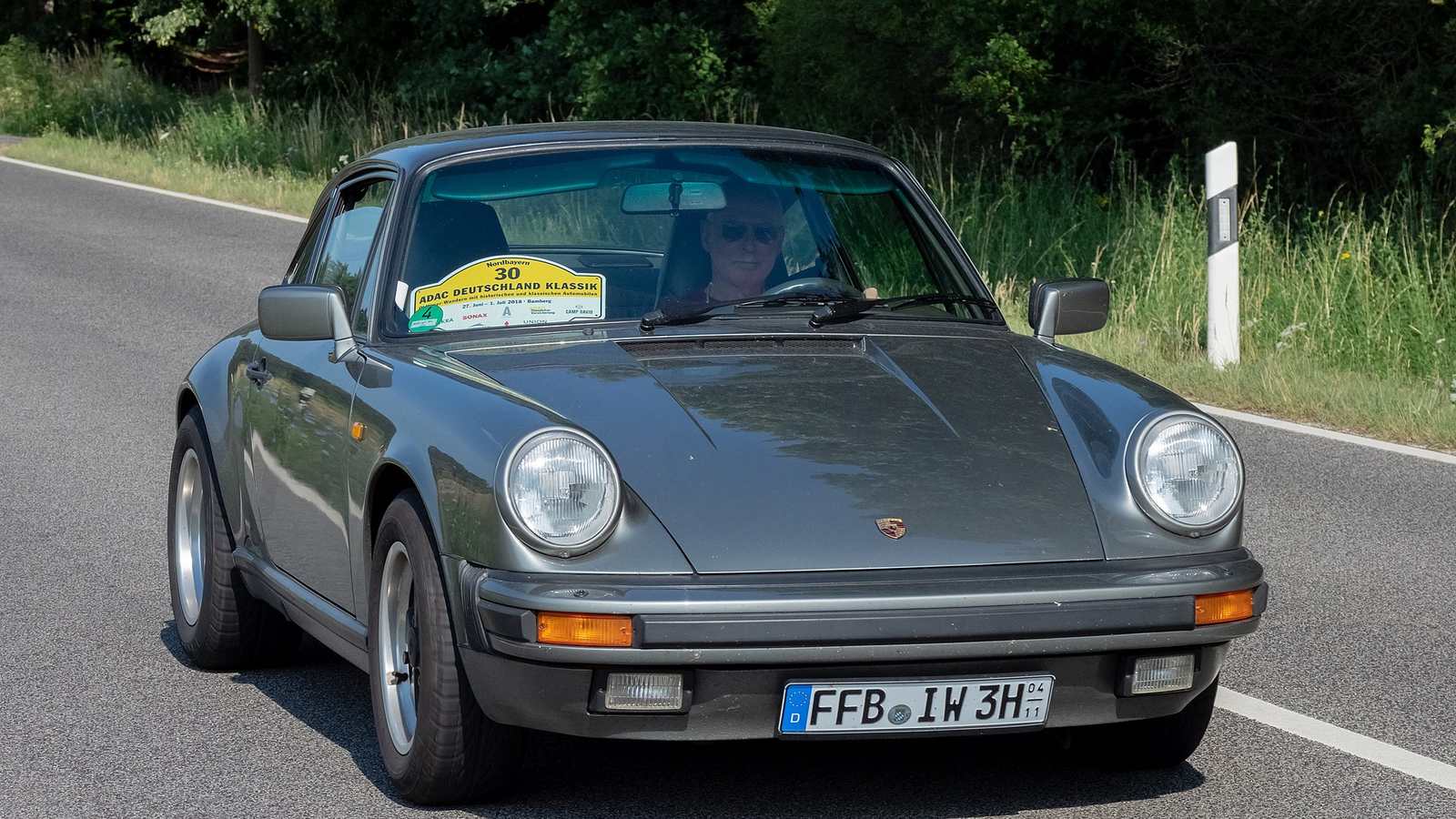
Porsche 911 (original and G-series)
1964–1989

- Years
- 1964–1989
- Engine
- 2.0 to 3.3 air-cooled flat-six
- Power
- 110–300 PS
- Weight
- about 1,030–1,335 kg
The 911 was shown at the Frankfurt motor show in September 1963 as the 901 and went on sale in 1964. Peugeot held the rights in France to three-digit model names with a zero in the middle, so the car was renamed 911 before deliveries had properly begun. It had a new 2.0-litre air-cooled flat-six with 130 PS, mounted behind the rear axle, and a body designed under Ferdinand Alexander 'Butzi' Porsche.
The Targa, with its fixed roll hoop and removable roof panel, was shown in 1965 and named after the Targa Florio. Engines grew to 2.2 and 2.4 litres, and in 1972 Porsche built the Carrera RS 2.7 to homologate the car for racing: 210 PS, a ducktail spoiler and a little over 1,500 built.
The G-series arrived for the 1974 model year with impact bumpers to meet American regulations. It ran in various forms for fifteen years: the 2.7, the Carrera 3.0, the 911 SC from 1978 and the Carrera 3.2 from 1984. The 911 Turbo, known internally as the 930, was launched in 1975 with 260 PS and gained a 3.3-litre intercooled engine with 300 PS in 1978. Bodies were galvanised from the mid-1970s, which is one reason so many survive.
Variants
| Variant | Years | Notes |
|---|---|---|
| 911 2.0 / 911 S / T / E | 1964–1973 | The original short- and long-wheelbase cars; 912 with a four-cylinder engine alongside. |
| Carrera RS 2.7 | 1972–1973 | 210 PS homologation car; the most sought-after road 911. |
| 911 2.7 / Carrera 3.0 | 1973–1977 | First impact-bumper cars. |
| 911 SC | 1978–1983 | 3.0 litres, 180 to 204 PS; cabriolet from 1983. |
| Carrera 3.2 | 1984–1989 | 231 PS (less in catalyst markets); G50 gearbox from 1987. |
| 911 Turbo (930) | 1975–1989 | 260 PS 3.0, then 300 PS 3.3; four-speed until the final year. |
On a road trip
An SC or Carrera 3.2 is one of the best classic cars to take a long way: compact, narrow enough for any pass, simple to work on and able to cruise all day. The front boot and folding rear seats take a surprising amount of luggage. The handling is honest but old-fashioned. Lifting off the throttle sharply in the middle of a wet corner will bring the rear round, so brake in a straight line and drive the car out on the power.
What to check
- Rust on pre-galvanised cars and on any car with poor accident repairs: sills, kidney bowls, B-posts, front wings and around the screens.
- Broken cylinder head studs on 2.7, SC and 3.2 engines, and pulled studs in the magnesium crankcases of the 2.7.
- Timing chain tensioners on cars built before the pressure-fed type was introduced for 1984; most have been updated.
- Oil leaks, worn valve guides (blue smoke on start-up) and tired suspension bushes.
- Turbo cars: check for heat damage, a tired turbocharger and evidence of careless modification.