Rear-engined 2+2 coupé, Targa and cabriolet
Porsche 911 (964)
1989–1994
,_Bauzeit_1989-94_(2018-06-30_Sp).jpg)
- Years
- 1989–1994
- Engine
- 3.6 air-cooled flat-six; 3.3 and 3.6 turbo
- Power
- 250–360 PS
- Weight
- about 1,350–1,470 kg
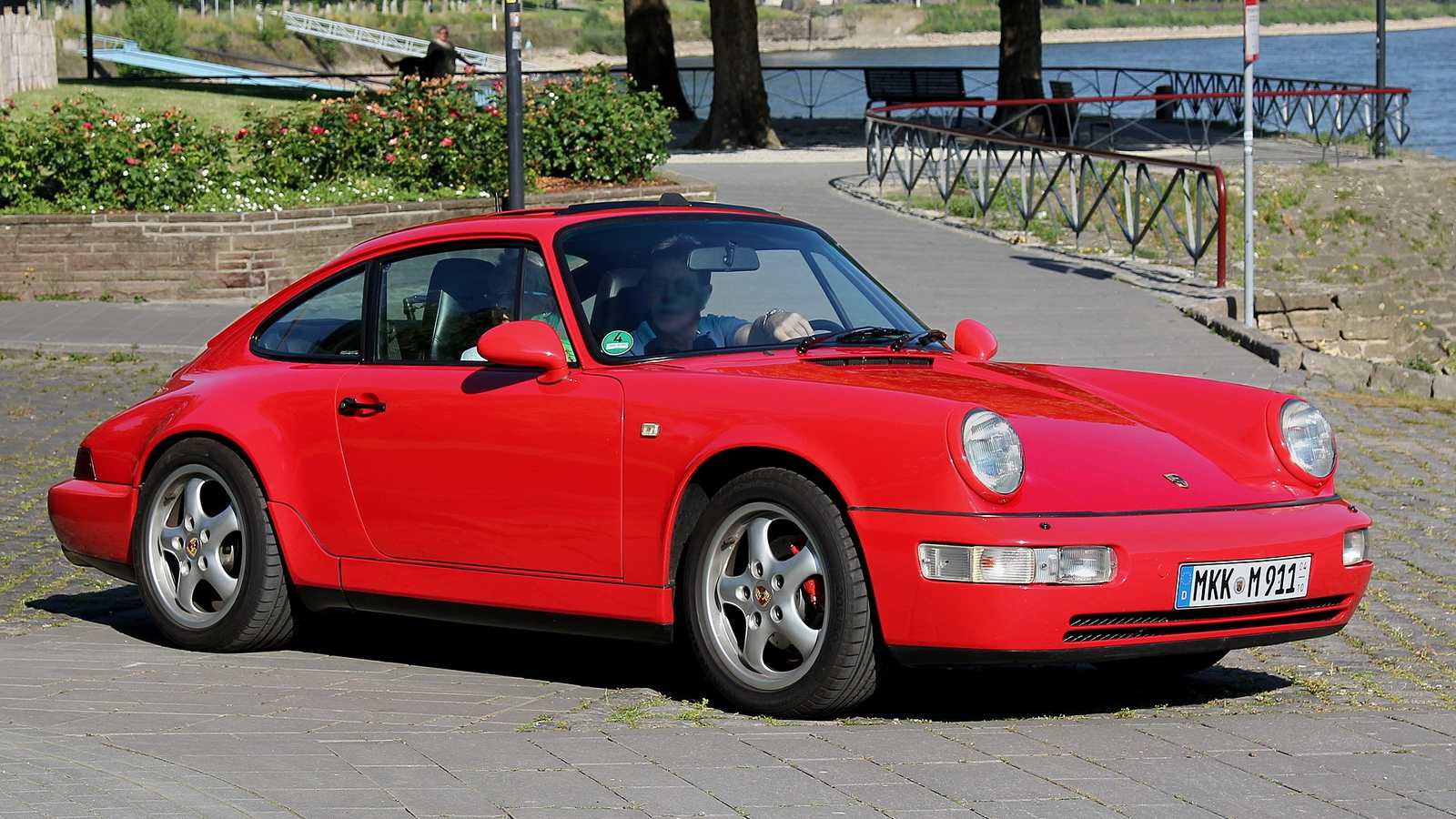
The 964 looked like a gently modernised G-series, but Porsche described it as about 85 per cent new. Coil springs replaced the torsion bars that had been used since 1964, and power steering and ABS became standard. The engine was a new 3.6-litre twin-spark flat-six with 250 PS.
It was launched as the four-wheel-drive Carrera 4, with a system developed from experience with the 959. The rear-drive Carrera 2 followed for 1990, along with the Tiptronic automatic. A retractable rear spoiler rose at speed.
The Carrera RS of 1991 and 1992 was a stripped, stiffened car with 260 PS, and the Turbo returned first with the old 3.3-litre engine and then, for 1993, with a 360 PS 3.6. Around 63,000 cars of all types were built.
Variants
| Variant | Years | Notes |
|---|---|---|
| Carrera 4 | 1989–1994 | Four-wheel drive, 250 PS. |
| Carrera 2 | 1989–1994 | Rear-wheel drive; manual or Tiptronic. |
| Carrera RS | 1991–1992 | 260 PS, lightened; not officially sold in the US, which got the RS America. |
| Turbo 3.3 / Turbo 3.6 | 1990–1994 | 320 PS, then 360 PS. |
| Speedster / Turbo-look cabriolet | 1992–1994 | Late-production specials. |
On a road trip
The 964 is the point where the 911 became easy to live with without losing its character. Power steering and ABS take the effort out of a long mountain day, the car is still narrow, and the engine has strong mid-range pull. A Carrera 4 is reassuring on a wet pass. An RS is firm to the point of discomfort on a poor surface.
What to check
- Oil leaks from the cylinder-to-head joint on early engines, which were built without a head gasket; later engines were revised.
- Dual-mass flywheel failure on early Carrera 2 cars.
- The twin distributors are linked by a small belt; if it breaks, the engine can be damaged. A vent kit was introduced to extend belt life.
- Rust around the windscreen and rear screen, and in the front wings near the fuel filler.
- Air conditioning and the electrically raised rear spoiler.