Rear-engined 2+2 coupé, Targa and cabriolet
Porsche 911 (993)
1993–1998

- Years
- 1993–1998
- Engine
- 3.6 and 3.8 air-cooled flat-six; 3.6 twin-turbo
- Power
- 272–450 PS
- Weight
- about 1,370–1,500 kg
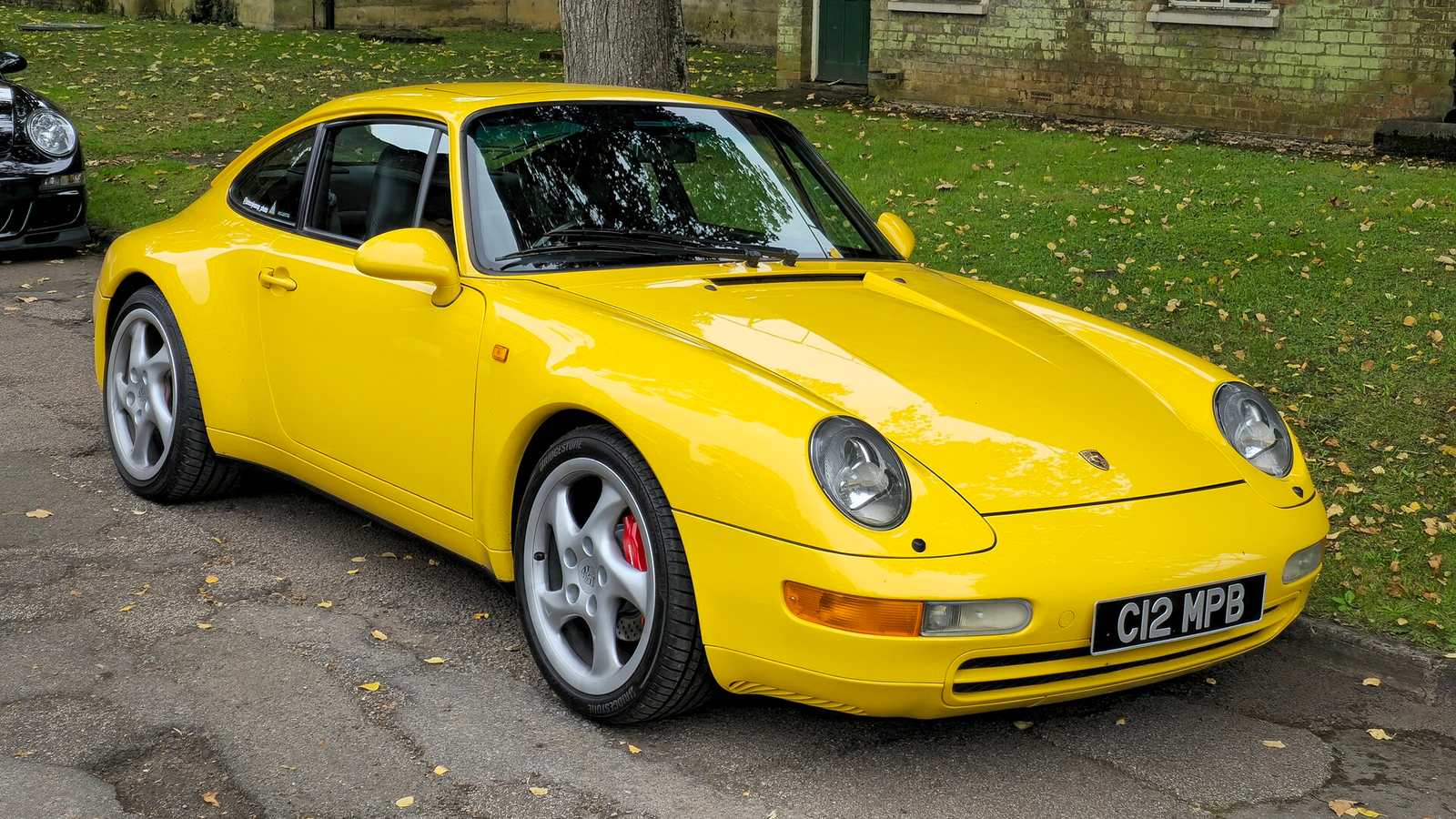
The 993 was the last 911 with an air-cooled engine, and for many people that makes it the most desirable of the modern classics. The body, styled by Tony Hatter, kept the 911's roof and glass but smoothed and widened everything below it.
The important engineering change was at the back. A new multi-link rear axle carried on a subframe replaced the semi-trailing arms, and it took much of the snap out of the 911's behaviour at the limit. The 3.6-litre engine produced 272 PS at launch and 285 PS from 1996, when the Varioram variable intake was added. A six-speed manual gearbox was standard.
The 1995 Turbo was the first 911 Turbo with twin turbochargers and four-wheel drive, with 408 PS. The Carrera RS used a 3.8-litre engine with 300 PS, and the rear-drive GT2 was built to homologate the racing car.
Variants
| Variant | Years | Notes |
|---|---|---|
| Carrera / Carrera 4 | 1993–1998 | 272 PS, then 285 PS with Varioram. |
| Carrera S / Carrera 4S | 1995–1998 | Wide Turbo body with the naturally aspirated engine. |
| Targa | 1995–1998 | Sliding glass roof in place of the lift-out panel. |
| Turbo | 1995–1998 | 408 PS twin-turbo, four-wheel drive. |
| Carrera RS / GT2 | 1995–1998 | 300 PS 3.8 RS; 430 PS, later 450 PS, GT2. |
On a road trip
Arguably the best all-round air-cooled 911 for touring: compact, stable, properly quick and comfortable enough for long days. The six-speed gearbox makes motorway miles easier. Values are high, which changes how relaxed you feel about leaving it in a hotel car park, so choose accommodation with secure parking.
What to check
- Blocked secondary air injection ports, which trigger a check-engine light on later cars and are expensive to clear properly.
- Valve guide wear and the oil consumption that comes with it.
- Corrosion around the front and rear screen seals and on the bumper mounts.
- Provenance. High values attract misdescribed cars, so check the options codes and history against the chassis number.